Also, the market is dog friendly. Nigel approves!
Saturday, April 7, 2012
Dekalb Market
Today we took a nice long stroll to check out Dekalb Market in Downtown Brooklyn. The market is constructed of salvaged shipping containers turned into storefronts. The markets brings together artists, artisans, eateries, an incubator farm and a performance venue creating a community for creative entrepreneurs. Today was the opening weekend of the market for the season and there was a huge turnout. I love to see so many people supporting local and handmade goods and I think using shipping containers as storefronts is such a brilliant idea.

Also, the market is dog friendly. Nigel approves!
Thursday, April 5, 2012
Cosy Up the World
I am loving these bowls I just saw on freshly found via pinterest:
There is something about creating a cosy onto objects that makes them feel so special and loved. I love when I walk around my neighborhood and see a tree or pole wearing a sweater. Pretty much any inanimate with a sweater on it makes me happy. How can it not? There is a scientific term for this "cosying up" (another scientific term) of objects. It is Yarn Bombing or Yarn Storming (I kind of like that one). There are a half a million pictures that come up when you Google yarn bombing, from a bus in Philadelphia to a parking meter in Vancouver. There are some pretty amazing yarn bombed objects out there.
I am headed to Philadelphia next week to catch the tail end of FiberPhiladelphia. One of the exhibits I am going to check out is Yarn Bombing 101.
One artist that crochets the world is Agata Olek. Her work blows my mind. I missed her show in New York last year and would have loved to see this in person.
However, for the record I am not calling her artwork yarn bombing. Olek was quoted in the New York Times in 2011 saying:
"I don't yarn bomb, I make art. If someone calls my bull a yarn bomb, I get really upset. Lots of people have aunts or grandmas who paint. Do you want to see that work in the galleries? No. The street is an extension of the gallery. Not everyone’s work deserves to be in public."
Got it. However, since this is a post about covering inanimate objects with yarn, a mention of Agata Olek needs to be made. There are some pretty spectacular yarn bombs out there and I am sure the same arguments can be made about graffiti as art and yarn bombing as art but maybe we will save that debate for another day.
Either way, I like it. Yarn bombing, urban knitting, art. I love the softness it creates and how an everyday object covered in yarn can make an everyday moment feel whimsical. The feeling that someone has given so much attention to an object that we would otherwise not think too much about, except for the particular function it serves. It just makes everything seem... cared for.
Did anyone read the article that Etsy put out on April Fools? (spoiler alert: it's not true). The article ends with:
"Subsequent phases of the plan call for outfitting Portland’s homes with knitted “sweaters” to reduce heating costs, designing a rotating seasonal wardrobe for the city’s signature 34-foot-tall Portlandia statue, and reverse-engineering brick-and-mortar restaurants into hemp-powered food trucks."
We won't talk about the fact that I actually believed this article to be true from start to finish and was so blown away by the idea of actually making sweaters for houses, that my heart completely sank when I read the editors note. It took me a good while to really think it was a cute and funny article because I was so sad and disappointed that it wasn't true. Why can't we have knitted house sweaters? Now I can't stop hoping I will wake up one day and my apartment building will be wearing a sweater.
Although, Agata Olek does live nearby...... so maybe one day.
There is something about creating a cosy onto objects that makes them feel so special and loved. I love when I walk around my neighborhood and see a tree or pole wearing a sweater. Pretty much any inanimate with a sweater on it makes me happy. How can it not? There is a scientific term for this "cosying up" (another scientific term) of objects. It is Yarn Bombing or Yarn Storming (I kind of like that one). There are a half a million pictures that come up when you Google yarn bombing, from a bus in Philadelphia to a parking meter in Vancouver. There are some pretty amazing yarn bombed objects out there.
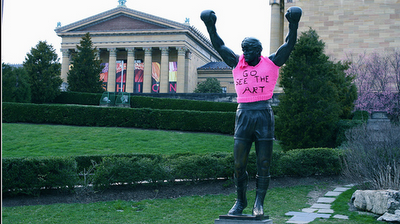
I am headed to Philadelphia next week to catch the tail end of FiberPhiladelphia. One of the exhibits I am going to check out is Yarn Bombing 101.
![]() |
| Rocky Statue in Philadelphia |
One artist that crochets the world is Agata Olek. Her work blows my mind. I missed her show in New York last year and would have loved to see this in person.
![]() | |||||||
| photo: agataolek.com |
![]() |
| photo: agataolek.com |
However, for the record I am not calling her artwork yarn bombing. Olek was quoted in the New York Times in 2011 saying:
"I don't yarn bomb, I make art. If someone calls my bull a yarn bomb, I get really upset. Lots of people have aunts or grandmas who paint. Do you want to see that work in the galleries? No. The street is an extension of the gallery. Not everyone’s work deserves to be in public."
Got it. However, since this is a post about covering inanimate objects with yarn, a mention of Agata Olek needs to be made. There are some pretty spectacular yarn bombs out there and I am sure the same arguments can be made about graffiti as art and yarn bombing as art but maybe we will save that debate for another day.
Either way, I like it. Yarn bombing, urban knitting, art. I love the softness it creates and how an everyday object covered in yarn can make an everyday moment feel whimsical. The feeling that someone has given so much attention to an object that we would otherwise not think too much about, except for the particular function it serves. It just makes everything seem... cared for.
Did anyone read the article that Etsy put out on April Fools? (spoiler alert: it's not true). The article ends with:
"Subsequent phases of the plan call for outfitting Portland’s homes with knitted “sweaters” to reduce heating costs, designing a rotating seasonal wardrobe for the city’s signature 34-foot-tall Portlandia statue, and reverse-engineering brick-and-mortar restaurants into hemp-powered food trucks."
We won't talk about the fact that I actually believed this article to be true from start to finish and was so blown away by the idea of actually making sweaters for houses, that my heart completely sank when I read the editors note. It took me a good while to really think it was a cute and funny article because I was so sad and disappointed that it wasn't true. Why can't we have knitted house sweaters? Now I can't stop hoping I will wake up one day and my apartment building will be wearing a sweater.
Although, Agata Olek does live nearby...... so maybe one day.
![]() |
| photo: phantomgalleries |
Thursday, March 29, 2012
Pin It
Sometimes when I am feeling stuck creatively I try to make something in less than 30 minutes without really thinking about the outcome as kind of a warm up to get things flowing. The instant gratification of a finished product will keep me satisfied so I can keep working on a longer more time consuming project. The other day I whipped up a pincushion from an old silk dress, some wool batting, and a tea cup and when it was done with it I was able to continue on with my embroidered drawing with a little more skip in my step (lilt in my wrist?). Anyways... curious to see what was happening in the handmade pincushion world, I got lost in Etsy land for a good bit and here are some of my favorites that I came across:
![]() |
| pear with handmade pins by digitsdesigns |
![]() |
| felted wool bird on embroidered feed sack by magpiejane |
![]() |
| toadstool house by hippywitch |
![]() |
| flying pig by lifepieces |
![]() |
| whale friends by blueberry bandit |
![]() |
| heirloom tomatoes by rosebudoriginals |
![]() |
| miniature watering can by mmwolters |
tiny pond and cattails, first snow frosty mushrooms and evergreen woodland fir tree
These are all just such sweet little treasures! Would love to find one (or more?) of these in my basket come Easter...
*A little history lesson regarding the origin of the classic tomato pincushion: Dating back to the 15th century, people believed that keeping a ripe tomato in the home on a mantel or entry way would bring prosperity and repel evil spirits. Since real tomatoes were not available throughout the year people would make them with fabric and fill them with straw or sawdust. The stuffed fabric tomato eventually began being used as a pincushion!
Tuesday, March 27, 2012
Charleston Garment Manufactory
In continuing along the same lines of local economy and sustainable fashion, check out Charleston Garment Manufactory on Indiegogo. Heather Koonse, owner and creator of The Rose Knot (a clothing and alteration shop) is raising funds to turn The Rose Knot into a brand new resource center for existing and future designers. She plans to work with local designers and individuals to produce their clothing by offering design consultations, pattern drafting, sample garment construction and sewing classes, as well as strengthening and building the community through education.
Labels:
indiegogo,
sewing,
sustainable clothing
Location:
brooklyn, new york
Monday, March 26, 2012
Women's Work
Etsy posted a wonderful video last week on their blog about Alabama Chanin, a clothing line started by Natalie Chanin, that has employed women from her community in Florence, Alabama to create beautiful hand sewn pieces for the past decade.
I was so inspired that I continued reading and found this video of Natalie at Hello Etsy Berlin speaking about connecting your business to your community. I love everything about her story of arriving at this point of running a successful cottage industry run business that powers the local economy while staying true to her values - not to mention her down to earth southern charm and appreciation for the traditions of her heritage. I also love the idea of a woman run business using quilting and stitching techniques passed down from generations of women living in the rural south by women who otherwise would not be employed using a skill that is such a part of who they are.
I found the part in the video interesting when she was talking about how some people in the industry were referring to their company as being elitist because of the prices of the garments. The garments are made from organic cotton that is grown in the United States when possible and sewn completely by hand (not machine) and can take one person 4 to 6 weeks to complete (while also paying the artisan a living wage). She was approached to write a book and happily accepted the idea so that people would be able to create the garments themselves or could pay someone else in their community to make it. Once people realized what went into these heirloom garments and how time consuming it was to create one piece people could better understand and appreciate their worth.
You can order books here, as well as sign up for weekend retreats in their studio! I can't think of anything dreamier than a weekend in the south sipping cocktails, eating biscuits and stitching your own Alabama Chanin inspired garment...Sign me up.
I was so inspired that I continued reading and found this video of Natalie at Hello Etsy Berlin speaking about connecting your business to your community. I love everything about her story of arriving at this point of running a successful cottage industry run business that powers the local economy while staying true to her values - not to mention her down to earth southern charm and appreciation for the traditions of her heritage. I also love the idea of a woman run business using quilting and stitching techniques passed down from generations of women living in the rural south by women who otherwise would not be employed using a skill that is such a part of who they are.
I found the part in the video interesting when she was talking about how some people in the industry were referring to their company as being elitist because of the prices of the garments. The garments are made from organic cotton that is grown in the United States when possible and sewn completely by hand (not machine) and can take one person 4 to 6 weeks to complete (while also paying the artisan a living wage). She was approached to write a book and happily accepted the idea so that people would be able to create the garments themselves or could pay someone else in their community to make it. Once people realized what went into these heirloom garments and how time consuming it was to create one piece people could better understand and appreciate their worth.
You can order books here, as well as sign up for weekend retreats in their studio! I can't think of anything dreamier than a weekend in the south sipping cocktails, eating biscuits and stitching your own Alabama Chanin inspired garment...Sign me up.
www.alabamachanin.com
Labels:
cottage industry,
hand-sewn,
sustainable clothing
Location:
brooklyn, new york
Wednesday, February 29, 2012
Welcome to the a la main first official blog post! I will be posting about all things handmade-project ideas, recipes, beautiful and interesting objects that people are making, my own projects and work, features on artists, artisans and craftspeople as well as any other interesting tidbits on anything made by hand. Suggestions and comments will always be welcomed!
Subscribe to:
Posts (Atom)